12 Graphs
Graphs are a very flexible family of data structures used in a wide range of applications. Like trees, there is no single graph data structure, but rather a family of similar data structures. A graph always consists of a set of vertices (nodes) and a set of edges, where each edge connects two vertices. Here are visual representations of two small graphs.
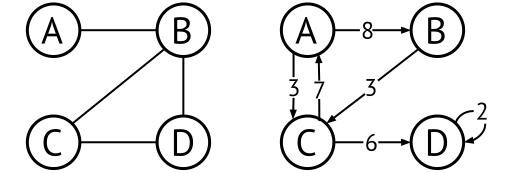
Graphs are used to model both real-world systems and abstract problems. Modelling a domain as a graph involves considering what vertices and edges represent. Here is a small sampling of what graphs can be used to model:
- Computer- and communications networks: Vertices are computers and edges are direct network connections.
- Train networks with distances: Vertices are the train stations and edges are the railway tracks between them.
- Scheduling of tasks in a complex activity (such as compiling a program or building a house): Vertices are tasks and edges represent their dependencies – that a task depends on another task to finish before it can start.
- Any kind of relationships, for example between social media users: Vertices are users, edges are relationships such as friendship, following or blocking.
- The World Wide Web: Vertices are web pages and edges are links.
- The memory content of a running program: Vertices are objects and edges are references or pointers.
The next section covers basic graph terminology, and the rest of the chapter covers core graph algorithms including traversal, shortest path algorithms, and minimum spanning tree algorithms, as well as common representations and implementations of graphs.